Gateweave Cloud keeps its data in the EU: what moved, what didn't, and how to do the same
Yiğit Tanrıverdi ·
If your company is European, “where is our data?” is the first question about any hosted tool. For Gateweave Cloud the honest answer used to be “partly in North America”, and Track’s database had only a location hint, which is a preference and not a promise. As of November 13, the answer is shorter, and this post says what it covers and what it doesn’t.
Gateweave Cloud is the hosted version of Track, Agents and ID. It is run by one person, me, and Gateweave is the name of a project, not a company. That is on the privacy policy, along with everything below. This post says no more than that page does, and if the two ever disagree, the page is right.
What is in the EU
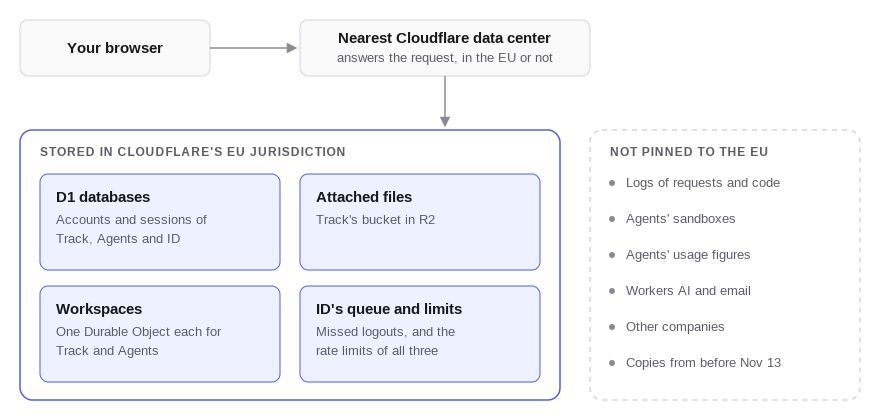
Cloudflare has a setting called a jurisdiction.
Something created in the eu jurisdiction is stored in data centers in the EU, and its databases run
only there. That is a guarantee, where a location hint is only a preference. These parts of
Gateweave Cloud are in it now:
- Every database. The D1 databases of Track, Agents and ID, which hold accounts, sessions, passkeys, apps and the list of workspaces, and the one behind the waitlist.
- Track’s attached files. The bucket in R2.
- Every workspace. Each Track and each Agents workspace is a Durable Object, or several for Agents, with its own SQLite database. This is where your issues, comments, conversations and runs live, so it was the part that mattered most.
- ID’s logout queue and its rate limits, and the rate limits of Track and Agents.
New workspaces are made in the EU from the start.
What is not, and why
This part is longer on purpose.
- The data center that answers your request. Cloudflare answers each request at the data center nearest to whoever made it, which can be outside the EU, so what you send and see passes through it. The jurisdiction is about where data is stored and where the databases run, not about the path a request takes.
- Logs. Cloudflare logs each request to Track, Agents and ID, with the IP address, approximate location, browser, the address requested and the result. They are kept for seven days, and Cloudflare can store them in its data centers anywhere.
- Agents’ sandboxes. Update, November 19: they are in the EU after all; see the note at the end. An agent that works on a repository runs in a container, and containers can’t be pinned to a jurisdiction: Cloudflare starts them wherever it has room. A repository copied into one, and what an agent does there, stays there until the sandbox is deleted. On Gateweave Cloud, sandboxes are open to invited workspaces only for now.
- Agents’ usage figures. One record per run, with its agent, model, tokens and cost, and no messages or people in it, is kept by Cloudflare in no particular place.
- Workers AI and email. They are processed where Cloudflare runs them.
- Other companies. If a workspace uses a model from Anthropic, OpenAI or Google with its own key, connects GitHub or signs people in with GitHub, those companies are mostly in the United States and have their own terms. Those are a team’s choices.
- What we held before November 13. The old copies stay where they were, partly in North America, until I delete them. They are not removed yet. A workspace’s old copy is sealed: it takes no writes and no connections, and it is kept until the workspace is deleted.
So your data can still be processed outside the EU. The privacy policy says so too, and says what Cloudflare’s agreements cover for that. This post is not legal advice, and it doesn’t say that Gateweave Cloud is compliant with anything. It says where things are.
Why moving was the hard part
D1 databases and R2 buckets were the easy part: you create a new one with the jurisdiction and copy everything into it. Durable Objects are different. Cloudflare doesn’t move one when you ask for a jurisdiction. The same name in the EU is a new, empty object with its own storage, so each workspace has to be copied into one, and the old one frozen while that happens.
The daily run does this a few workspaces at a time, and each is paused for a few seconds while its rows are copied and checked against the original. I wrote the details up on dev.to, including what broke: You can’t move a Durable Object to the EU. Here’s how I copied live ones anyway. If you only want to know what it did to your workspace: it was paused for those few seconds, its clients reconnected, and it carried on.
Doing the same on your own account
All of this is optional, and none of it changes a server you run unless you ask. Each part is set on its own, and the self-hosting guides have the exact steps: Track, Agents and ID.
- The database. Create it with
--jurisdiction eubefore the first deploy, as inpnpm wrangler d1 create gateweave-track --jurisdiction eu. A database’s jurisdiction can’t change once it exists, so a server that already runs needs a new database and a copy. - Track’s files. Create the bucket with
--jurisdiction eutoo, and put"jurisdiction": "eu"on theFILESbinding inwrangler.jsonc. - Workspaces, and rate limits. Set
DURABLE_OBJECT_JURISDICTIONtoeuon Track, Agents and ID. New workspaces are made there, and in Track and Agents the daily run moves the older ones, three at a time. Unsetting it later moves nothing back. Without the setting, nothing changes. - ID’s logout queue. Create it with
--jurisdiction eu, before the first deploy. - Agents’ repository wikis. Give the Workflow in
wrangler.jsonca"jurisdiction", and a newname, because a Workflow’s jurisdiction is fixed when it is made. - Agents’ sandboxes. There is nothing more to set: a sandbox’s container runs where its Durable Object does, so the Durable Objects’ jurisdiction covers it (see the note at the end).
What it doesn’t do yet
- It doesn’t make everything EU-only, as the list above says.
- The old copies are still there until I delete them, and Track’s sealed workspace copies stay until the workspace is deleted. Clearing one sooner isn’t built.
- Nothing moves back if you unset the setting.
- I’m one person. If your lawyers need more than the privacy policy says, write to me at the address on it.
Try it, or ask
Sandboxes in Agents and Workers AI are for invited workspaces, and Gateweave Mail isn’t open yet. The waitlist is where to ask for those, and I write when something opens. I won’t promise a date. If you’d rather keep everything in your own hands, all of it is open source and runs on your own Cloudflare account: Track, Agents and ID each have a self-hosting guide, with a section on keeping the data in one jurisdiction.
What else would you need to know before trusting a hosted tool with your team’s issues? Tell me what’s missing from this list. It’s the list I’d want to read myself, and the privacy policy gets changed when the answer is that it’s wrong.
Update, November 19
Agents’ sandboxes are in the EU too. This post was wrong to say they couldn’t be kept there:
- How it works. A sandbox’s container is started by its Durable Object, and Cloudflare runs such a container where the object runs. Ours have been in the EU jurisdiction since November 13.
- What we measured. Every sandbox container started since then ran in an EU data center: Warsaw, Bucharest, Prague and Milan. Before the move, they ran in the US.
- The image. The image a container starts from is our code and holds none of your data.
The privacy policy says this as of today.
Update, November 21
The old copies are gone. Every database, file bucket, queue and workspace copy we held outside the EU before November 13 has been deleted:
- Databases, queues, files and the wiki Workflows. The old ones were deleted on November 18 and 19, after checking that nothing had used them for a day and that the EU copies held everything they did.
- Workspaces. Track and Agents now erase a workspace’s sealed old copy a week after it moved. The first runs that could, early on November 21, erased every one of them.
The privacy policy no longer lists the old copies. The other exceptions in the list above still stand.
Claude Code wrote this post and checked what it says against the privacy policy, the three products’ code and their changelogs. Where it says “I wrote” or “I delete”, it is an agent writing for me, and the privacy policy is the text to rely on, not this.